
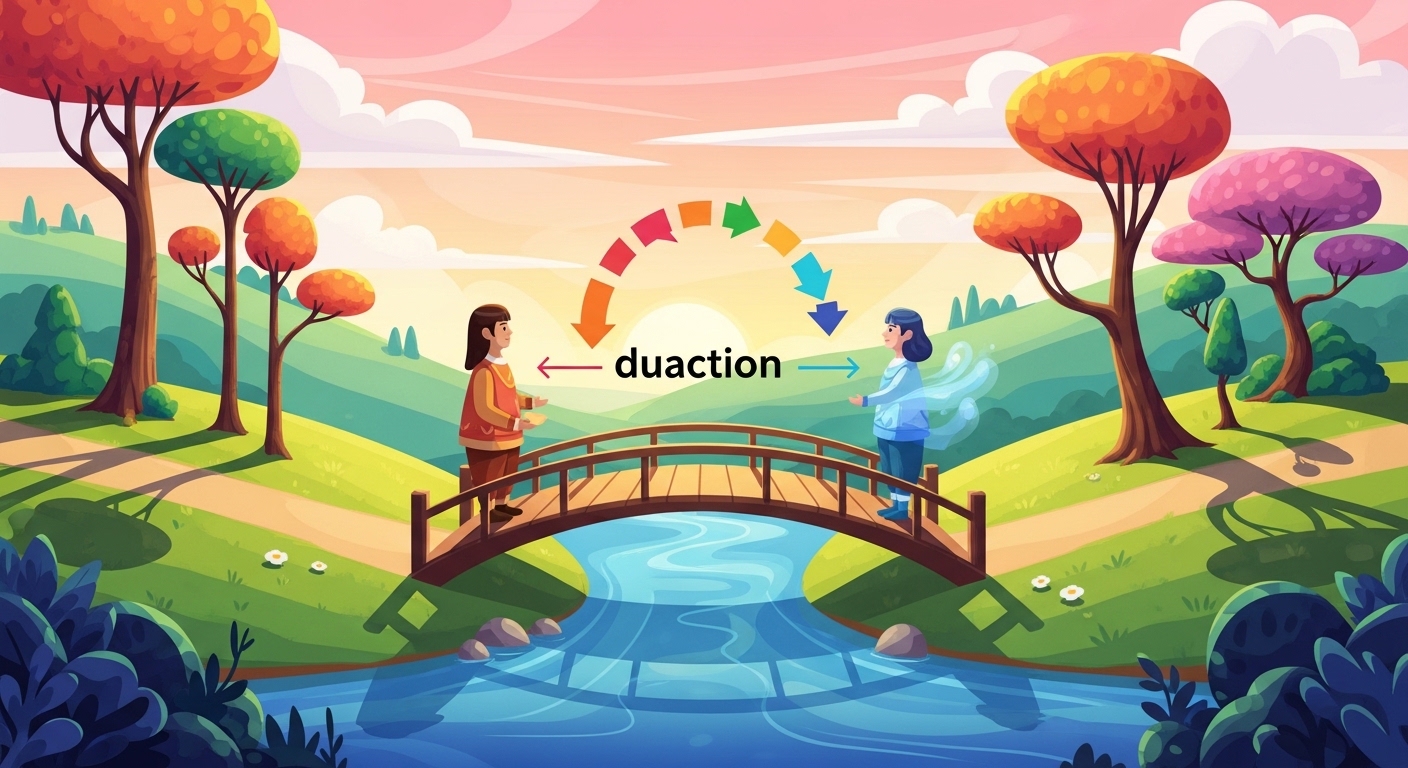
Key Points
- Duaction describes the natural two-way flow of giving and receiving in every conversation, where both people actively listen, respond, and adjust in real time.
- Evidence from psychology shows that balanced interactions build trust and reduce stress, while one-sided patterns often leave people feeling exhausted or undervalued.
- Simple daily shifts, such as matching energy and checking in on the other person’s perspective, can create more satisfying connections at home and work.
- Research suggests these principles improve empathy and relationship satisfaction without requiring major overhauls.
What Duaction Really Means: Think of duaction as turning a monologue into a dialogue that loops back and forth. One person shares, the other responds thoughtfully, and both adapt. This mutual exchange feels fair and energizing. Sites dedicated to modern communication define it as “joint action” where participants influence each other on purpose rather than talking past one another.
Why Balance Matters in Everyday Life: When interactions stay one-sided, resentment can quietly build. Studies on reciprocity note that people in unbalanced exchanges report higher stress and lower life satisfaction. The good news is that anyone can learn to restore the balance. Small habits like active listening and timely follow-up make interactions feel supportive instead of draining.
Quick Ways to Start Practicing:
- Notice who initiates most conversations and gently invite the other person to lead sometimes.
- After sharing your thoughts, ask “What do you think?” and really pause to hear the answer.
- In the workplace or with your partner, summarize what you heard before adding your own view.
These steps draw from well-established ideas in social psychology and can fit into busy schedules without feeling forced.
Have you ever left a coffee chat or team meeting feeling strangely empty, even though words were exchanged? You poured out ideas, asked questions, and tried to connect, yet the other person seemed to absorb without giving much back. That subtle imbalance is exactly what duaction helps us spot and fix. Duaction is the dual, reciprocal pulse of healthy human connection. It turns ordinary talk into shared experience where both sides give, receive, and grow together.
Recent explorations of the term describe duaction as an interaction model built on two-way action. Instead of a straight line from speaker to listener, it forms a living loop. Each participant actively engages, responds in the moment, and influences the direction of the exchange. The result feels purposeful and balanced. This concept aligns closely with long-standing psychological ideas like social exchange theory and the norm of reciprocity, which remind us that relationships thrive when effort flows both ways.
Understanding Duaction in Daily Life
At its heart, duaction rests on mutual awareness. You speak, I listen and reflect. I share, you respond and build on it. This back-and-forth creates psychological equilibrium. Without it, conversations become transactions where one person invests more emotional energy than the other. Over time, that drains the giver and leaves the receiver less connected than they realize.
Consider a simple evening at home. One partner recounts a tough day at work while the other nods, checks their phone, and offers a quick “That sounds rough” before changing the subject. The exchange happened, but duaction did not. Contrast that with both partners taking turns, asking follow-up questions, and offering support that feels genuine. The difference is palpable: one interaction leaves you lighter, the other heavier.
In friendships the pattern shows up when you are always the one texting first or remembering birthdays. Research on interpersonal dynamics finds that roughly half of friendships lack full reciprocity, which can quietly erode closeness. The same principle applies at work. When a manager shares feedback but rarely invites input, or when colleagues dominate meetings without inviting quieter voices, collaboration suffers.
How Duaction Influences Modern Relationships
Today’s fast-paced world makes balanced exchange harder. Digital tools let us broadcast thoughts instantly, yet they often reduce the natural feedback loop. A quick emoji reply replaces a thoughtful conversation. Over time these shortcuts weaken relational symmetry. Studies tracking social trends report that Americans now spend less time in face-to-face contact with friends than they did a decade ago, contributing to what some call a “friendship recession.” The percentage of adults reporting no close friends has risen sharply since the 1990s.
Duaction counters this drift. It encourages us to slow down enough for real mutual understanding. When both people feel heard, emotional intelligence grows naturally. You begin to anticipate needs, celebrate wins together, and navigate disagreements without keeping score. The cycle of duaction, give, receive, adjust, strengthens bonds and creates a sense of safety.
The Role of Duaction in Workplace Communication
Professional settings amplify the stakes. Poorly balanced interactions cost organizations thousands per employee each year in lost productivity and higher turnover. When team members feel their ideas are welcomed and responded to, engagement rises. Leaders who practice duaction ask for input, acknowledge contributions, and adjust plans based on what they hear. The result is fewer misunderstandings and stronger behavioral feedback loops.
Imagine a project meeting where one person presents a plan and then opens the floor with genuine curiosity. Colleagues build on the idea, offer concerns, and together refine it. That is duaction in action. Contrast it with a leader who talks for forty minutes and ends with “Any questions?” followed by silence. The second scenario breeds disengagement. Applying duaction principles here improves collaboration without fancy training programs.
Signs of Poor Duaction in Friendships and Partnerships
Spotting imbalance early prevents bigger problems. Common red flags include:
- You initiate most plans or check-ins.
- Conversations revolve around one person’s concerns while the other’s receive brief replies.
- Support flows mostly one direction, creating emotional exhaustion.
- Feedback feels absent or defensive rather than collaborative.
These patterns match descriptions of one-sided relationships found across psychology resources. In romantic partnerships, asymmetrical commitment often predicts lower satisfaction and higher breakup rates. In friendships, the giver may feel taken for granted while the receiver remains unaware of the growing distance.
Psychological Benefits of Practicing Duaction
Balanced interactions deliver measurable gains. People in reciprocal relationships report higher life satisfaction and lower depressive symptoms. The act of truly listening and responding builds empathy muscles. Over time this fosters mutual understanding and reduces the mental load of wondering whether your efforts matter.
Social exchange theory explains why. When costs (time, energy, vulnerability) roughly equal rewards (support, validation, growth), the relationship feels fair and worth maintaining. Duaction keeps the equation healthy by making the exchange visible and adjustable in real time.
Applying Duaction Principles for Better Empathy
Improving duaction starts with awareness and small experiments. Here are practical steps that fit busy lives:
- Match and mirror energy. If a friend shares excitement, respond with matching enthusiasm before adding your own story.
- Use reflective listening. After someone speaks, briefly restate what you heard: “It sounds like the deadline stress is really weighing on you.” Then invite more.
- Share the stage. In group settings, notice who has spoken less and create space for them.
- Check the loop. At the end of important talks, ask “Did that feel helpful for both of us?” This simple question reinforces relational symmetry.
- Adapt in the moment. If you sense the other person pulling back, gently name it: “I notice we’ve been focusing on my side, how are you feeling about all this?”
These habits draw directly from active listening techniques and the cyclical nature of duaction described in communication literature. They require no special tools, just intention.
Common Mistakes to Avoid
Even well-meaning people slip into unbalanced patterns. One frequent error is assuming the other person “just knows” you care. Without visible reciprocity, assumptions breed doubt. Another is over-giving without pausing to receive, which can lead to burnout. A third is using digital shortcuts that feel efficient but skip emotional depth.
You might wonder if perfect balance is realistic. The answer is no, and that is okay. Life brings seasons when one person needs more support. Duaction is not about keeping exact score. It is about noticing imbalance and gently restoring flow before resentment sets in.
Improving Duaction with Your Partner
Couples who practice duaction report deeper intimacy. Try a weekly “state of the union” chat where each person speaks uninterrupted for five minutes while the other listens fully. Then switch. End by naming one thing each appreciated about the exchange. This structured loop builds communication patterns that carry into daily life.
Balanced Duaction Versus Unbalanced Patterns
| Aspect | Poor Duaction Example | Strong Duaction Example | Expected Outcome |
|---|---|---|---|
| Initiation | One person always texts or plans first | Both reach out naturally and take turns | Reduced resentment, more equality |
| Listening | Quick nods, topic changes | Reflective questions and summaries | Greater mutual understanding |
| Support Exchange | One offers help, rarely receives it | Both give and ask for help comfortably | Stronger emotional safety |
| Feedback | Defensive or absent | Open, timely, and solution-focused | Faster conflict resolution |
| Overall Energy | Draining for the giver | Energizing for both | Higher relationship satisfaction |
This comparison highlights how small shifts create noticeable differences.
Next Steps You Can Take Today
Choose one relationship, personal or professional, that feels slightly off-balance. For the next week, focus on creating one clear duaction moment each time you interact. Notice what changes. Most people report feeling more connected within days.
What is one small change you will try this week? Maybe it is simply asking “How did that land for you?” after sharing your thoughts. The beauty of duaction is that it rewards curiosity and consistency.
You May Also Like: Top Concepts Found in RN Fundamentals 2016 70 Questions
FAQs
What exactly is duaction?
Duaction is the mutual, active loop of giving and receiving in conversations and relationships, where both people engage, respond, and adapt together rather than one dominating the exchange.
Is duaction the same as reciprocity?
It builds on the psychological principle of reciprocity but emphasizes the real-time, purposeful cycle of action and reaction that keeps interactions feeling fair and alive.
Can duaction help in the workplace?
Absolutely. Teams that practice balanced communication see better collaboration, fewer misunderstandings, and higher engagement because everyone feels heard and valued.
How do I fix a one-sided friendship?
Start by gently increasing invitations for the other person to lead. Use reflective listening and openly share how the current pattern feels. If effort remains uneven, it may be time to invest energy elsewhere.
Does duaction require equal effort every single time?
No. Healthy relationships allow for seasons when one person needs more support. Duaction is about overall balance and the willingness to notice and adjust when the scale tips too far.
What if the other person does not reciprocate?
You cannot force duaction, but you can model it and invite participation. Clear, kind communication about your needs often prompts change. If not, protecting your energy becomes the healthy choice.
Are there psychological benefits to practicing duaction?
Yes. Research links reciprocal interactions to lower stress, higher life satisfaction, stronger empathy, and more resilient relationships across personal and professional settings.