
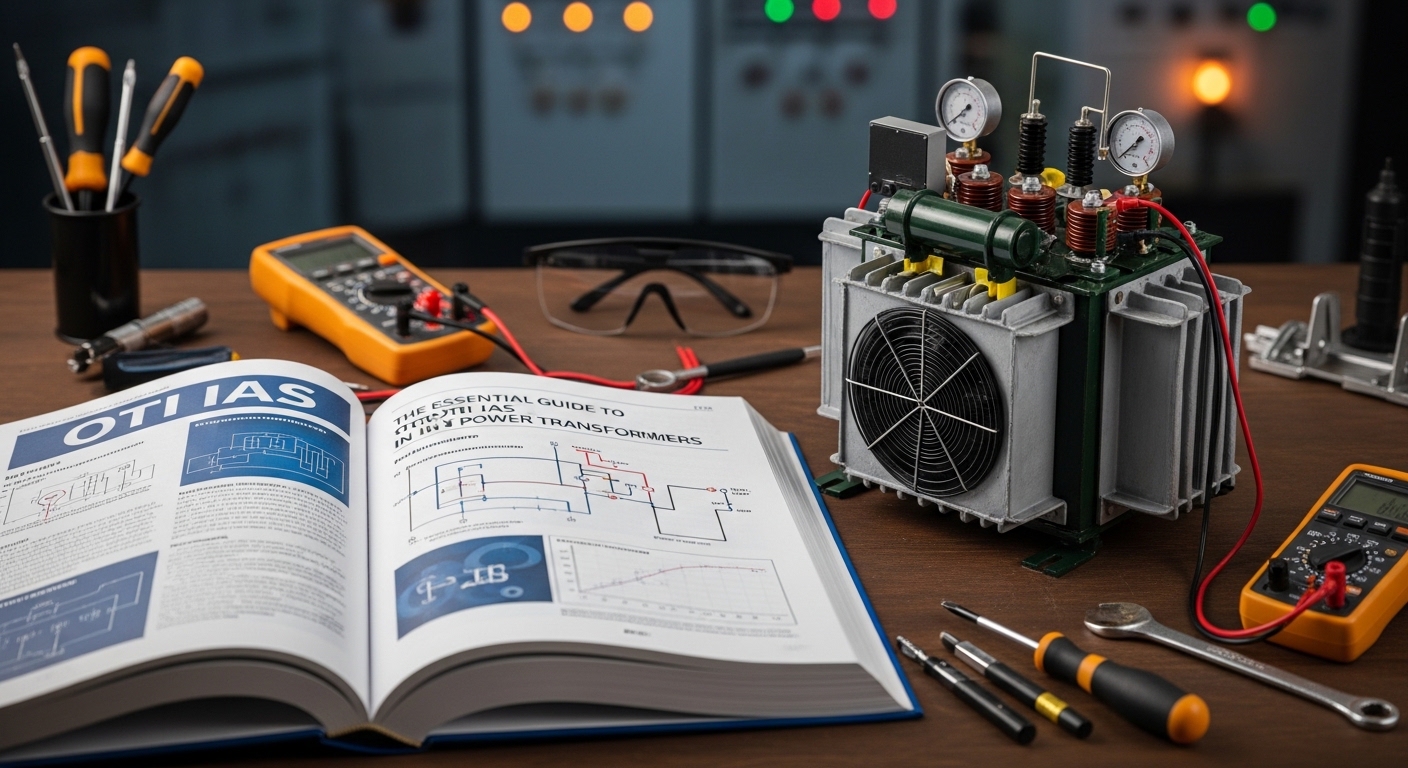
The OTI (Oil Temperature Indicator) and IAS (Internal Arc Sensor) serve as the essential nervous system for power transformers, providing critical monitoring of thermal dynamics and fault detection to prevent catastrophic failures. This guide delivers a comprehensive technical briefing for power professionals on how these systems function, their integration, and their role in ensuring equipment longevity and grid stability.
Note on Scope: While the OTI is a well-established device with extensive documentation, specific technical details and use cases for the IAS (Internal Arc Sensor/Alarm System) are less prevalent in the provided search results. The following information on IAS is therefore based on general engineering principles and common industry practices for internal arc protection in high-voltage equipment. For precise, application-specific guidance on IAS, consulting specialized manufacturers and detailed protection relay manuals is recommended.
Decoding the Transformer’s Nervous System: OTI and IAS
In the high-stakes environment of power distribution, a transformer failure is not just an equipment malfunction; it’s a systemic event with financial and safety repercussions. This is where the integrated OTI IAS system comes into play. Think of it as the transformer’s central nervous system: the OTI (Oil Temperature Indicator) is the sensory perception, constantly monitoring thermal health, while the IAS (Internal Arc Sensor/Alarm System) acts as the rapid-response pain reflex, detecting and initiating action against catastrophic internal faults. Together, they form the cornerstone of modern transformer monitoring systems, moving operators from reactive troubleshooting to predictive, condition-based maintenance.
The Oil Temperature Indicator (OTI): The Guardian of Thermal Dynamics
The OTI is a specialized device designed to monitor, display, and control the temperature of the insulating oil in a power transformer. Its role is critical because oil temperature is a direct indicator of the transformer’s operational state and the effectiveness of its cooling systems.
How It Works: From Bulb to Dial
The traditional OTI operates on a simple yet robust physical principle: liquid expansion.
- Sensing: A sensing bulb is placed in a thermometer pocket or well on the transformer’s top cover, where it is immersed in the top-oil layer—the hottest oil in the tank.
- Transmission: This bulb is connected to the indicator dial via a flexible capillary tubing. The entire sealed system (bulb and capillary) is filled with a temperature-sensitive fluid.
- Indication: As the oil temperature rises, the fluid expands, increasing pressure within the sealed system. This pressure is transmitted through the capillary to a bellows or Bourdon tube inside the indicator, which mechanically drives the pointer across a calibrated dial to display the temperature.
Modern digital OTIs replace this mechanical system with electronic sensors like RTDs (Resistance Temperature Detectors) or thermocouples, offering higher precision, data logging, and direct integration with SCADA systems.
Beyond Indication: Control and Protection
A key feature of the OTI is its integration with the transformer’s control and protection schemes. Most OTIs are equipped with adjustable micro-switches that activate at preset temperatures. This allows the OTI to:
- Initiate Cooling: Start cooling fans or oil pumps when a predetermined temperature is reached (e.g., 75-90°C), optimizing the transformer’s loading capacity.
- Trigger Alarms: Send a warning to the control room when the oil temperature exceeds normal operating limits (e.g., 80-95°C), indicating a potential overload or cooling system malfunction.
- Initiate Tripping: As a last line of defense, the OTI can trip the transformer’s circuit breakers if the temperature reaches a critical level (e.g., 95-110°C), preventing immediate failure due to rapid overheating.
The Importance of Top-Oil Temperature
Top-oil temperature is a vital health indicator. It provides a weighted average of the heat generated within the transformer. A gradual upward trend in top-oil temperature under consistent load, for example, can be the first clue that a cooling fan has failed or that radiators are clogged, allowing maintenance teams to intervene before the situation escalates.
The Winding Connection: Differentiating OTI and WTI
While the OTI measures oil temperature, it is the winding temperature that is most critical for insulation life. This is where the Winding Temperature Indicator (WTI) comes in, often working in tandem with the OTI.
- OTI: Measures the temperature of the oil itself.
- WTI: Measures (or simulates) the hot-spot temperature of the transformer windings. Since windings generate the heat, their temperature is always higher than the surrounding oil.
Traditional WTIs cleverly simulate this hot-spot temperature. They use the same bulb-and-capillary mechanism as an OTI, but the bulb is surrounded by a heater coil that is fed by a current transformer (CT) from the winding. The heat from this coil, proportional to the load current, is added to the top-oil temperature, providing an accurate simulation of the winding hot-spot. More advanced systems now use fiber optic sensors embedded directly in the windings for a direct, real-time measurement, eliminating estimation errors.
Internal Arc Sensor/Alarm System (IAS): The Last Line of Defense
While thermal monitoring manages long-term stress, the IAS addresses acute, catastrophic events. An internal arc fault in a transformer is a rare but violent occurrence, releasing immense energy in the form of heat, pressure, and gas. The primary goal of an IAS is to detect this event in its earliest milliseconds and initiate a response to minimize damage and ensure personnel safety.
Sensing the Catastrophic
An IAS typically relies on a combination of sensors to detect the distinct physical phenomena of an arc flash:
- Pressure Rise Detection: Internal arcs cause an instantaneous and dramatic pressure spike within the tank. Pressure sensors or rate-of-rise pressure switches are the most common and fastest method for detecting these events.
- Light Detection: An internal arc produces an intense flash of light. Optical sensors can detect this light, and are often used in a voting scheme with overcurrent or pressure relays to ensure the alarm is only triggered by an actual internal arc, not by external events like lightning strikes or switching surges.
- Gas and Oil Flow: Similar to a Buchholz relay, an IAS may also monitor for the massive surge of oil and gas from the conservator or through the piping that would accompany a violent internal fault.
System Response: Limiting the Damage
Once an IAS detects an internal arc, its primary function is to send a high-speed trip signal to the upstream circuit breaker. Speed is paramount; the goal is to de-energize the transformer before the pressure buildup can rupture the tank, which would lead to a fire and the release of hot oil and gases. This rapid isolation also limits the energy of the arc, reducing damage to the core and coils and potentially making the transformer repairable rather than a total loss.
Integrating OTI and IAS for Holistic Asset Management
The true power of an OTI IAS system is realized when these components are integrated into a unified transformer monitoring system. This integration allows for a comprehensive view of the asset’s health.
- Data Synergy: By correlating oil temperature data from the OTI with load profiles and ambient temperature, operators can optimize loading and plan maintenance. Historical temperature data is crucial for calculating insulation aging and predicting the remaining useful life of the transformer.
- Layered Protection: The OTI and IAS provide complementary layers of protection. The OTI guards against gradual thermal degradation, while the IAS provides a rapid-response safety net for violent internal faults. This layered approach is fundamental to power distribution safety.
- Digital Integration: Modern digital OTIs and IAS controllers are equipped with communication protocols like Modbus RS485 or 4-20mA analog outputs, allowing seamless integration with substation SCADA and EMS systems. This enables centralized monitoring, alarm management, and data logging for the entire transformer fleet.
Best Practices: Installation, Calibration, and Maintenance
To ensure the reliability of your OTI IAS system, a disciplined approach to installation and maintenance is non-negotiable.
Installation Pointers
- OTI Probe Positioning: Ensure the sensing bulb is fully inserted into the thermometer pocket, which is filled with oil or thermal compound for optimal heat transfer. Avoid sharp bends in the capillary tubing that could restrict fluid movement.
- Wiring: Use shielded cables for digital communication interfaces and ensure proper grounding. For contact wiring, route signals to the appropriate control relays or PLC inputs.
Calibration and Maintenance
- Routine Checks: During periodic inspections, verify the free movement of the dial pointer and that it returns to zero when cooled. Check the integrity of the capillary and its glands for signs of corrosion or damage.
- Setpoint Validation: Regularly test the alarm and trip contacts to ensure they actuate at their designated setpoints. This should be done at least annually or during major outages.
- Functional Testing: Simulate a fault condition (where safely possible) to test the entire chain, from the IAS sensor to the breaker trip circuit, ensuring no latency or failures in the protection loop.
The Future of Monitoring: Digital and Integrated
The trajectory of transformer monitoring is clear: towards greater digitization, integration, and intelligence. The traditional dial thermometer is giving way to the digital oti ias for power transformers. These advanced systems offer:
- High Accuracy and Resolution: Electronic sensors provide more precise readings than mechanical systems.
- Advanced Communication: Native support for SCADA and IoT platforms enables real-time data streaming and integration with wider grid management systems.
- Predictive Analytics: Continuous monitoring of temperature data, combined with load and ambient information, feeds algorithms that can predict cooling failures, detect abnormal thermal behavior, and provide a more accurate picture of insulation aging.
Conclusion
The OTI IAS system is far more than a collection of gauges and relays; it is a critical investment in the reliability and longevity of your power transformers. By diligently monitoring the thermal heartbeat of the asset with the OTI and providing an instantaneous defense against catastrophic internal faults with the IAS, this integrated system empowers power professionals to prevent failures, optimize performance, and ensure the highest levels of power distribution safety. In an era where grid stability is paramount, understanding and maintaining this “nervous system” is not just a technical task—it’s a core operational responsibility.
You May Also Like: Solo Et: From Niche Meme to Mainstream Social Media Slang