The final whistle at Levi’s Stadium told a story the scoreboard alone couldn’t capture. When the San Francisco 49ers walked off the field with a 37-24 victory over the Tennessee Titans on December 14, 2025, the box score revealed something fascinating: a game that was simultaneously a blowout and a battle. For fantasy football managers waking up on Monday morning, those tennessee titans vs 49ers match player stats offered both validation and frustration. Brock Purdy delivered a near-perfect performance. Tony Pollard proved his late-season surge was no fluke. And somewhere in the middle, a defensive tackle caught a touchdown pass.
Let’s break down exactly what happened, why it happened, and what these numbers mean for fans, analysts, and fantasy lineups moving forward.
Game Flow and Final Score Context
San Francisco 49ers 37, Tennessee Titans 24
| Quarter | 1st | 2nd | 3rd | 4th | Final |
|---|---|---|---|---|---|
| Titans | 3 | 7 | 0 | 14 | 24 |
| 49ers | 7 | 10 | 14 | 6 | 37 |
The 49ers never trailed in this game, but the final margin doesn’t tell the full story of Tennessee’s fight. San Francisco built what felt like an insurmountable 31-10 lead late in the third quarter, only for the Titans to scratch back within ten points twice in the final frame. The difference came down to two factors: third down efficiency and time of possession.
San Francisco converted 9 of 15 third down attempts (60 percent). Tennessee managed just 3 of 9 (33 percent). When you combine that with the 49ers holding the ball for over 37 minutes compared to Tennessee’s 22:55, the math becomes simple. You cannot win NFL games when your defense spends nearly two-thirds of the game on the field.
Team Statistics Comparison
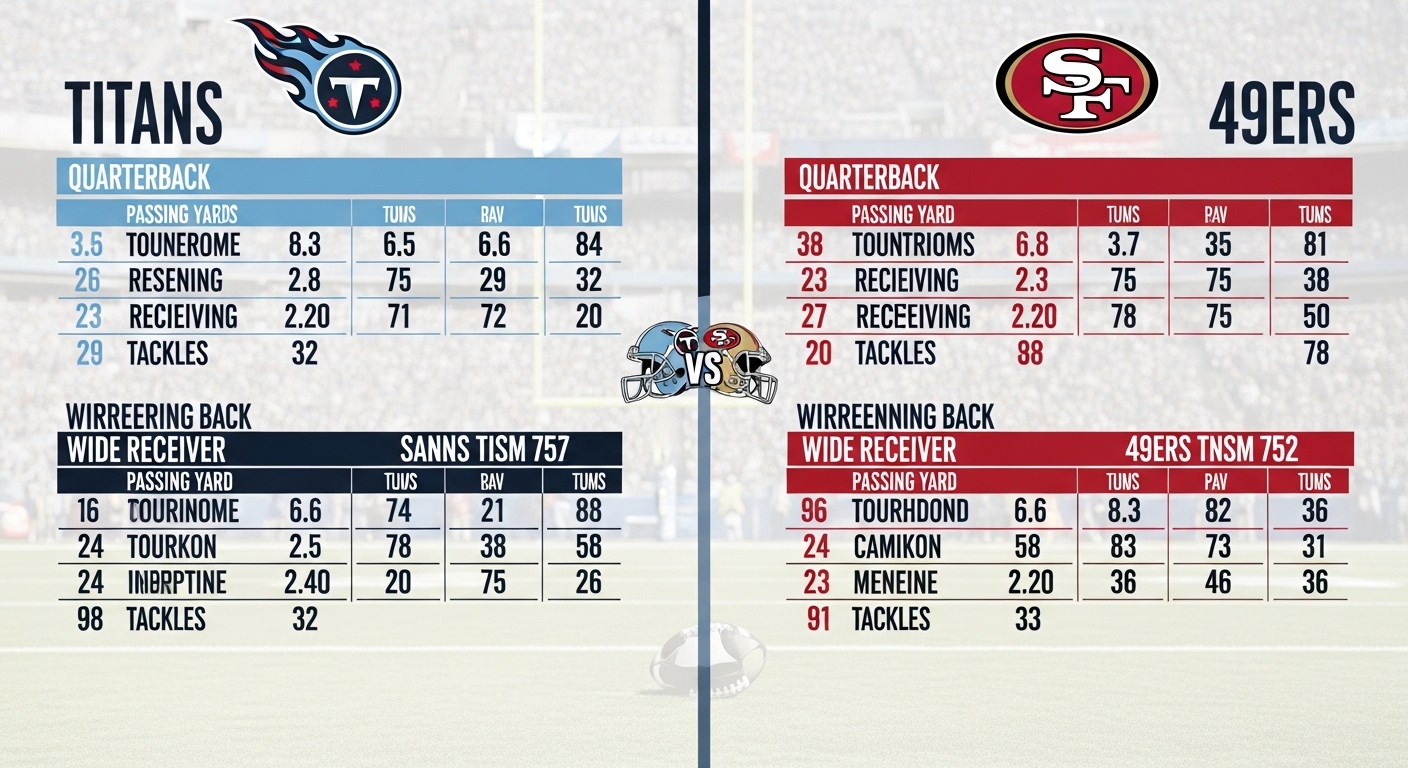
Before diving into individual performances, the team-level stats establish the battle lines:
| Statistic | Titans | 49ers |
|---|---|---|
| Total Yards | 306 | 430 |
| Passing Yards | 170 | 292 |
| Rushing Yards | 136 | 138 |
| First Downs | 18 | 28 |
| Turnovers | 0 | 1 |
| Penalties | 7-57 | 6-30 |
| Third Down Conv. | 3-9 (33%) | 9-15 (60%) |
| Fourth Down Conv. | 2-2 | 1-1 |
| Time of Possession | 22:55 | 37:05 |
| Red Zone Efficiency | 2-3 (67%) | 4-6 (67%) |
Here’s what jumps out: the 49ers generated nearly 100 more total yards despite identical rushing totals. That passing yardage differential 292 to 170 tells you who controlled the game through the air. Also note the turnover battle: Tennessee protected the football, yet still lost by double digits. When you lose the time of possession battle by nearly fifteen minutes, turnover margin becomes secondary.
Passing Game Breakdown: Quarterback Duel
Brock Purdy’s Near-Perfect Afternoon
Brock Purdy (SF): 23/30, 295 passing yards, 3 touchdowns, 0 interceptions, 140.3 passer rating, 7 carries for 44 rushing yards, 1 fumble lost
If you’re a 49ers fan wondering whether the Purdy we saw early in the season has returned, this game provided the evidence. Purdy completed 76.7 percent of his passes, averaged 9.8 yards per attempt, and posted a ridiculous 140.3 rating. Through three quarters, before the game entered garbage time, he had completed 17 of 22 passes for 235 yards and three touchdowns.
The most impressive aspect? Purdy spread the wealth while maintaining efficiency. He hit nine different receivers, kept drives alive with his legs (44 rushing yards on scrambles and designed runs), and showed no lingering effects from the toe issue that plagued him earlier in the year. The lone blemish was a fourth-quarter fumble, but by then the game was effectively decided.
One fan in the stands at Levi’s Stadium put it simply during the game: “Purdy is throwing some pinpoint passes today. He’s leading receivers better than ever”.
Cam Ward’s Promising Effort in Loss
Cam Ward (TEN): 18/29, 170 passing yards, 2 touchdowns, 0 interceptions, 101.2 passer rating, 1 carry for 2 rushing yards
For a rookie quarterback leading a 2-12 team into one of the loudest stadiums in football, Ward showed real poise. He didn’t turn the ball over. He managed the game within structure. And he delivered two touchdown passes, including a perfectly placed 34-yard strike to Gunnar Helm in the second quarter that briefly made it a one-score game.
The limitations are equally clear from the numbers. Ward averaged just 5.9 yards per attempt, nearly four full yards fewer than Purdy. The Titans offense functioned in short bursts rather than sustained drives. When you’re a rookie on a rebuilding team, though, zero interceptions and a 101 rating against a playoff contender counts as a step forward.
Receiving Corps: Distribution and Efficiency
49ers Pass Catchers
| Player | Receptions | Yards | Touchdowns | Long |
|---|---|---|---|---|
| George Kittle | 8 | 88 | 1 | 22 |
| Ricky Pearsall | 6 | 96 | 0 | 31 |
| Jauan Jennings | 3 | 37 | 2 | 13 |
| Demarcus Robinson | 2 | 36 | 0 | 21 |
| Kendrick Bourne | 2 | 17 | 0 | 9 |
| Christian McCaffrey | 1 | 14 | 0 | 14 |
| Kyle Juszczyk | 1 | 7 | 0 | 7 |
Ricky Pearsall’s breakout continued despite an ankle scare. The second-year wideout fought through a first-quarter injury to post team-highs in receptions and yards, showing why the 49ers invested heavily in his development. His 96 yards came on just six catches, good for a 16-yard average that consistently moved the chains.
George Kittle remains matchup-proof. Eight catches for 88 yards and a touchdown represents another dominant day for the tight end, who has developed almost telepathic chemistry with Purdy. His 1-yard touchdown catch in the third quarter capped a 15-play, 95-yard drive that ate over nine minutes off the clock. That’s the kind of possession that breaks opposing teams.
Jauan Jennings turned three catches into two touchdowns. The efficiency numbers don’t get much better than that. His 4-yard score opened the game’s scoring, and his 13-yard grab in the third quarter extended the lead to 24-10. Jennings remains Purdy’s preferred red zone target, a role that carries immense fantasy value.
Titans Pass Catchers
| Player | Receptions | Yards | Touchdowns | Long |
|---|---|---|---|---|
| Gunnar Helm | 4 | 49 | 1 | 34 |
| Chig Okonkwo | 4 | 33 | 0 | 12 |
| Chimere Dike | 4 | 17 | 0 | 6 |
| Van Jefferson | 1 | 43 | 0 | 43 |
| Elic Ayomanor | 1 | 17 | 0 | 17 |
| Tony Pollard | 1 | 8 | 0 | 8 |
| Tyjae Spears | 2 | 2 | 0 | 3 |
| Jeffery Simmons | 1 | 1 | 1 | 1 |
The Jeffery Simmons touchdown deserves special mention. The defensive tackle, inserted as a fullback in short yardage, caught a 1-yard pass from Ward in the fourth quarter. For fantasy managers in IDP leagues, that’s the kind of random scoring that wins or loses championships. More importantly, it showed the creativity Tennessee’s coaching staff still possesses even in a lost season.
Gunnar Helm continues to emerge as a reliable target. His 34-yard touchdown catch showed the speed that made him a draft target, and his four catches led the team. For a Titans team looking toward 2026, developing young pass catchers like Helm and Dike matters more than the win total.
Rushing Attack: Two Different Approaches
49ers Ground Game
| Player | Carries | Yards | Average | Touchdowns | Long |
|---|---|---|---|---|---|
| Christian McCaffrey | 22 | 73 | 3.3 | 1 | 8 |
| Brock Purdy | 7 | 44 | 6.3 | 0 | 12 |
| Brian Robinson Jr. | 8 | 21 | 2.6 | 0 | 7 |
Christian McCaffrey’s workload remains heavy even when the efficiency dips. Twenty-two carries for 73 yards isn’t the McCaffrey we remember from his Carolina peak, but the 1-yard touchdown run extended his scoring streak to four games. For fantasy purposes, volume remains king. McCaffrey also added a 14-yard reception, giving him 23 total touches in a game the 49ers controlled throughout.
The rushing numbers tell a story of game script. San Francisco ran 30 times for 138 yards, but the 4.6 average per carry was inflated by Purdy’s scrambles. Robinson averaged just 2.6 yards on eight carries, struggling to find room against a Titans front that knew passing situations were limited.
Titans Ground Game
| Player | Carries | Yards | Average | Touchdowns | Long |
|---|---|---|---|---|---|
| Tony Pollard | 14 | 104 | 7.4 | 1 | 22 |
| Tyjae Spears | 3 | 34 | 11.3 | 0 | 24 |
| Kalel Mullings | 1 | 3 | 3.0 | 0 | 3 |
| Cam Ward | 1 | 2 | 2.0 | 0 | 2 |
| Chimere Dike | 1 | -7 | -7.0 | 0 | -7 |
Tony Pollard is playing the best football of his career. For the second straight week, he topped 100 yards rushing. His 7.4 yards per carry against a 49ers defense missing several key starters showed exactly why he remains a valuable fantasy asset even on a struggling team.
Here’s the context that matters: Pollard likely would have seen 20-plus carries if the game remained close. But with San Francisco building a 21-point lead, Tennessee was forced into passing situations. His 104 yards came on just 14 attempts, meaning every time he touched the ball, good things happened. The 6-yard touchdown run in the fourth quarter showcased his vision and burst.
Tyjae Spears provided explosive relief with three carries for 34 yards, including a 24-yard burst. The rookie continues to show big-play ability in a complementary role.
Red Zone Efficiency: The Decisive Factor
Both teams converted 67 percent of their red zone opportunities into touchdowns, but the volume difference tells the story.
San Francisco: 4 touchdowns on 6 red zone trips
Tennessee: 2 touchdowns on 3 red zone trips
The 49ers reached the red zone twice as often. That’s the game. When you give an efficient offense like San Francisco’s six opportunities inside the 20, they’re going to score points. Purdy’s three touchdown passes all came from inside the 13-yard line, showing his precision in tight windows.
For Tennessee, the red zone trips were limited but productive. Ward’s touchdown pass to Simmons and Pollard’s run both came from inside the 6-yard line. The issue wasn’t finishing drives, it was starting them.
Defensive Impact: Sacks, Turnovers, and Pressure
The defensive numbers require context because neither team generated significant pressure.
Sacks: San Francisco recorded 2 sacks, Tennessee recorded 0
Turnovers: San Francisco lost 1 fumble, Tennessee committed 0 turnovers
Points off turnovers: 0 for both teams
This game featured surprisingly clean football from a turnover perspective. The 49ers defense, playing without Nick Bosa, Fred Warner, and several other starters, failed to record a takeaway. The Titans defense couldn’t generate sacks despite facing a quarterback they needed to pressure.
The 49ers did sack Ward twice, though full defensive player stats weren’t immediately available. More importantly, San Francisco’s banged-up secondary held up despite missing opportunities for interceptions. Malik Mustapha and Ji’Ayir Brown both dropped potential picks, mistakes that kept Tennessee drives alive.
All-Time Series Context: Where This Game Fits
The tennessee titans vs 49ers match player stats from this game add another chapter to a surprisingly competitive historical series.
All-time record (including Houston Oilers era): 49ers lead 10-6
The series dates back to 1970, when the Oilers fell to the 49ers 30-20. Tennessee’s last win came in 2021, a 20-17 victory. The 49ers have now won three of the last four meetings.
For Titans fans looking at the 6-9 all-time record against San Francisco, this loss stings less than some others. The 2025 team entered Levi’s Stadium with just two wins, playing a rookie quarterback against a playoff contender. The 37-24 final actually represents one of the more competitive losses in a difficult season.
Fantasy Football Impact: Winners and Streamers
For fantasy managers who stayed up late checking tennessee titans vs 49ers match player stats for fantasy purposes, here’s the bottom line:
Start with confidence moving forward:
- Brock Purdy (23.4 fantasy points in standard scoring)
- George Kittle (14.8 points with room for more)
- Tony Pollard (16.4 points on limited touches)
- Ricky Pearsall (15.6 points, emerging as WR1)
Hold but manage expectations:
- Christian McCaffrey (13.3 points on heavy volume, efficiency down)
- Jauan Jennings (15.7 points on just 3 catches, touchdown-dependent)
Streaming considerations:
- Cam Ward (12.6 points, safe floor for superflex leagues)
- Titans D/ST (0 points, avoid against good offenses)
The biggest takeaway: Purdy’s rushing floor (44 yards) combined with his passing efficiency makes him a QB1 rest of season. Pollard’s receiving work (1 catch for 8 yards) limits his ceiling slightly, but 100-yard rushers don’t grow on trees.
Where to Find Historic Matchup Comparisons
For analysts and fans seeking historic tennessee titans vs 49ers match player stats comparison, Pro-Football-Reference maintains the complete database. The 2025 meeting marked the 16th regular season game between the franchises, with San Francisco extending their series lead.
When comparing this game to the tennessee titans vs 49ers match player stats last 5 meetings, a pattern emerges: the 49ers control time of possession and win through the air. In the 2021 Tennessee victory, the Titans held the ball for 33 minutes and won 20-17. In 2025, San Francisco’s 37-minute advantage produced 37 points.
Five Key Takeaways for Fans and Analysts
1. Third down efficiency predicts outcomes. San Francisco’s 60 percent conversion rate against Tennessee’s 33 percent explains the 13-point final margin better than any other stat.
2. Brock Purdy is peaking at the right time. Three touchdowns, 295 yards, 140 rating, and 44 rushing yards against a defense missing starters but still NFL-caliber.
3. Tony Pollard deserves RB1 consideration. Back-to-back 100-yard games on a bad offense screams talent over situation.
4. The 49ers secondary depth will be tested. Dropped interceptions and missed tackles against a rookie quarterback raise concerns for playoff matchups.
5. Cam Ward provides hope for 2026. Zero turnovers, two touchdowns, and a 101 rating in a road loss against a playoff team represents real progress.
You May Also Like: Nueraji vs Crosbie Prediction: Who Wins This PFL Clash?
Frequently Asked Questions
Where can I find the official Tennessee Titans vs 49ers match player stats?
Official box scores are available through the NFL’s official website, ESPN, The Athletic, and Pro-Football-Reference. The most comprehensive offensive stats from this game were compiled by the Nashville Tennessean and distributed through multiple platforms.
How do these stats compare to the last five meetings between these teams?
The 49ers have won three of the last four meetings dating back to 2017. This game featured the highest point total (37) for San Francisco in the series since their 31-17 win in 2013. The 430 total yards by the 49ers represents their second-highest output against Tennessee all-time.
Which players had the best fantasy performances in this game?
Brock Purdy (23+ points), George Kittle (14+), Tony Pollard (16+), and Ricky Pearsall (15+) led all scorers in standard formats. Jauan Jennings scored two touchdowns on just three catches, making him a volatile but explosive weekly option.
What was the Most Crucial play that affected player stats?
The 15-play, 95-yard drive in the third quarter that consumed over nine minutes and ended with Kittle’s touchdown effectively ended competitive play. That drive alone produced 95 of Purdy’s 295 yards and ran clock that prevented Tennessee from establishing offensive rhythm.
How did injuries impact the final player stats?
The 49ers played without Nick Bosa, Fred Warner, and several defensive starters, which contributed to Tennessee’s ability to score 24 points despite limited offensive production. Ricky Pearsall played through an ankle injury and still led the team in receiving.
What do these stats mean for the Titans’ rebuild?
Cam Ward’s clean game (0 turnovers) against a playoff-caliber defense provides building blocks. Pairing his development with Pollard’s rushing production gives Tennessee offensive pillars heading into 2026. The defensive stats, particularly zero sacks, highlight offseason needs.
Were there any unusual statistical occurrences in this game?
Defensive tackle Jeffery Simmons catching a 1-yard touchdown pass qualifies as the game’s statistical anomaly. It marked his first career receiving touchdown and briefly gave Titans fans something to cheer about in a losing effort.